
“Who Calls the Shots?”: Mykola Bielieskov Analysed Institutional Conflicts in Ukraine’s Defence Sector for RUSI
Mykola Bielieskov, Senior Analyst at the CBA Initiatives Center, has written an article for the British think tank Royal United Services Institute (RUSI). He examined the new appointments to the leadership of Ukraine’s Ministry of Defence and Armed Forces in July 2026 and outlined a broader issue — the conflict between the Ministry of Defence and the General Staff of the Armed Forces of Ukraine over the strategic management of the war. The article is available to RUSI subscribers.
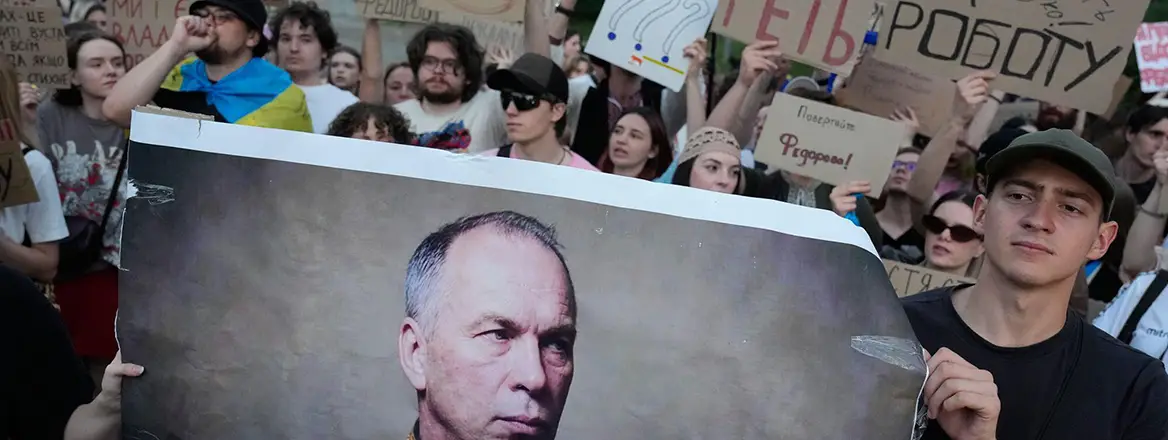
July 2026 saw major personnel changes in Ukraine’s military and defence leadership. After the government resigned, Defence Minister Mykhailo Fedorov left office. The president subsequently dismissed General Oleksandr Syrskyi, Commander-in-Chief of the Armed Forces of Ukraine, who had held the position since February 2024. Yevhen Khmara, who had previously served in the Security Service of Ukraine, was appointed Defence Minister, while Major General Mykhailo Drapatyi from the Joint Forces Command became Commander-in-Chief of the Armed Forces.
Against this backdrop, mass protests erupted over the president’s personnel decisions, bringing the conflict between Fedorov and Syrskyi into renewed focus. Western media outlets largely offered a rather superficial interpretation of the conflict, portraying it as a clash between a young manager with a technocentric approach and an old-school general steeped in the Soviet way of war. Tensions have been explained, among other factors, by different worldviews and styles.
However, according to Mykola Bielieskov, the conflict had much deeper roots and reflected three institutional problems:
- the conflict between the Ministry of Defence and the Commander-in-Chief of the Armed Forces / General Staff over the strategic management of the war;
- the dual role of Commander-in-Chief of the Armed Forces;
- the weak command at the middle level.
The Conflict Between the Ministry of Defence and the Commander-in-Chief Over the Strategic Management of the War
The Law "On National Security of Ukraine" stipulates that the Ministry of Defence oversees national defence policy and that the Armed Forces are subordinate to it. In practice, however, disagreements arise between the Ministry of Defence and the General Staff over the division of responsibilities for managing the Armed Forces.
According to Mykola Bielieskov, the prevailing unofficial view within the General Staff is that the Ministry of Defence should perform a procurement function for the Armed Forces. If the ministry’s leadership accepts this role, disagreements may remain out of the public eye. However, when the Ministry of Defence seeks to become involved in the strategic management of the Armed Forces, the conflict intensifies. This is what happened following Mykhailo Fedorov’s appointment as Defence Minister.
The analyst believes that without a clear division of responsibilities between the Ministry of Defence and the General Staff, tensions between the two institutions could intensify again in the future.
The Dual Role of Commander-in-Chief of the Armed Forces
Ukrainian legislation assigns two major responsibilities to the Commander-in-Chief of the Armed Forces: force generation and strategic planning in both peacetime and wartime, as well as direct military command and control.
According to the analyst, it is physically and mentally demanding for one person to perform both functions effectively. Under the NATO model, by contrast, these functions are separated: the military leadership is responsible for force generation with the most probable scenarios of force application in mind, while other structures exercise command and control over specific force groupings.
Mykola Bielieskov believes that Ukraine needs to clearly separate these functions, drawing on NATO’s experience.
The Weak Command at the Middle Level
This problem concerns the ability of middle-level command to exercise command and control over troops independently. When the Commander-in-Chief is compelled to become directly involved in commanding troops on the front line, he is unable to focus on strategic management through force generation and campaign planning, both of which are his core responsibilities.
The transition to a corps-based structure and the establishment of force groupings are intended to reduce the centralisation of decision-making at the highest levels of military command. However, this process is still ongoing.
"Ukraine's top political leaders must resolve two key issues: establishing a clear civil-military relations model — specifically for the MoD and Commander-in-Chief / General Staff — and clarifying the roles of the Commander-in-Chief while enhancing command and control at the operational level. Without addressing these, Ukraine's defence and security sectors risk dysfunction during wartime and may fail to achieve essential outcomes,”
the analyst notes.
At the same time, according to Mykola Bielieskov, addressing all these problems requires not only legislative changes but also a cultural shift and attitude change toward adopting the NATO model outlined in the 2018 law.

Cooperation Between the CBA Initiatives Center’s Analytics Department and RUSI
Mykola Bielieskov has previously contributed analytical articles to RUSI. More broadly, analysts at the CBA Initiatives Center maintain regular engagement with the British think tank, including providing expert advice to its specialists on Ukrainian defence and security issues.
Founded in 1831, the Royal United Services Institute (RUSI) is one of the United Kingdom’s oldest and most respected think tanks. It specialises in international security and military affairs. Its analytical publications are read by defence officials, parliamentarians, military personnel, intelligence and sanctions policy specialists, journalists and other subject-matter experts.
Articles submitted to RUSI undergo editorial review, ensuring their expert quality and adherence to standards for analytical publications. Publishing articles on the Russia-Ukraine War through RUSI provides an opportunity to share Ukrainian experience and expertise with an international audience, including subject-matter experts and those involved in shaping security and defence policy across different countries.
Share