
“War Has Many Dimensions. It Can Wear a Uniform or a Diplomatic Suit”: Maria Kucherenko’s Speech at the European Parliament
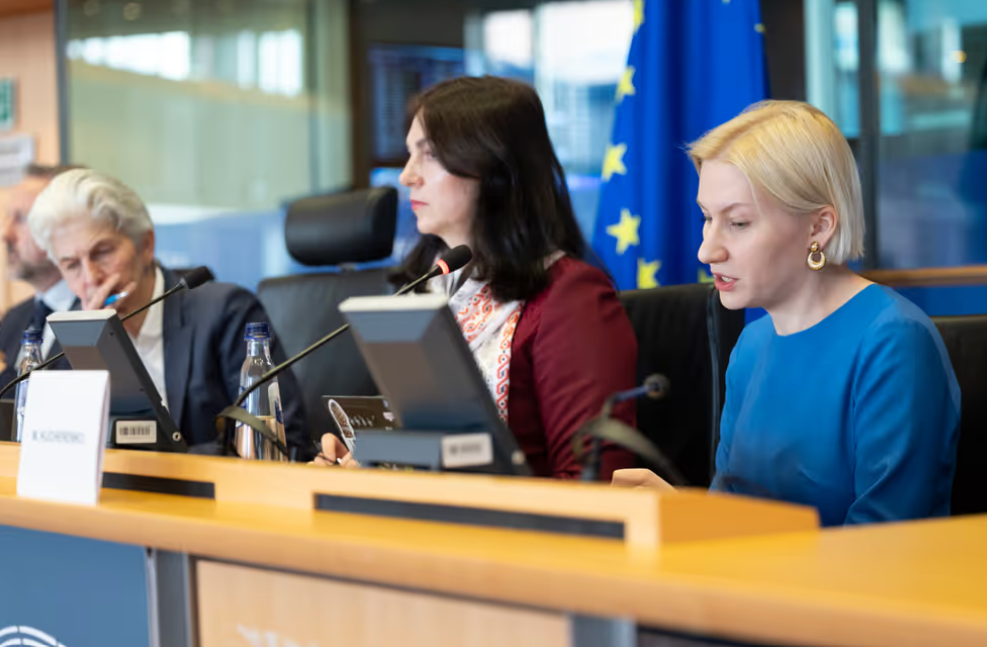
On Wednesday, March 18, 2026, Maria Kucherenko, Senior Analyst at the Come Back Alive Initiatives Center, addressed a hearing of the European Parliament’s Committee on Security and Defence. She joined the Ukrainian delegation in briefing European colleagues on Ukraine’s experience in the war in which Russia attacked Ukraine, as well as on challenges that extend far beyond our country.
The session was chaired by Committee Chair Marie-Agnes Strack-Zimmermann. Such hearings serve as an important platform for direct dialogue between Ukraine and European institutions. They make it possible not only to present facts but also to foster a deeper understanding of the nature of the threats facing Europe as a whole.
Today, speeches by Ukrainian experts in international institutions are more than an exchange of experience. They provide an opportunity to clearly articulate that Russia’s aggression is systemic, multidimensional, and directed not only against Ukraine. This is precisely why supporting Ukraine—politically, financially, and militarily—is not merely a matter of solidarity but a matter of security for all of Europe.
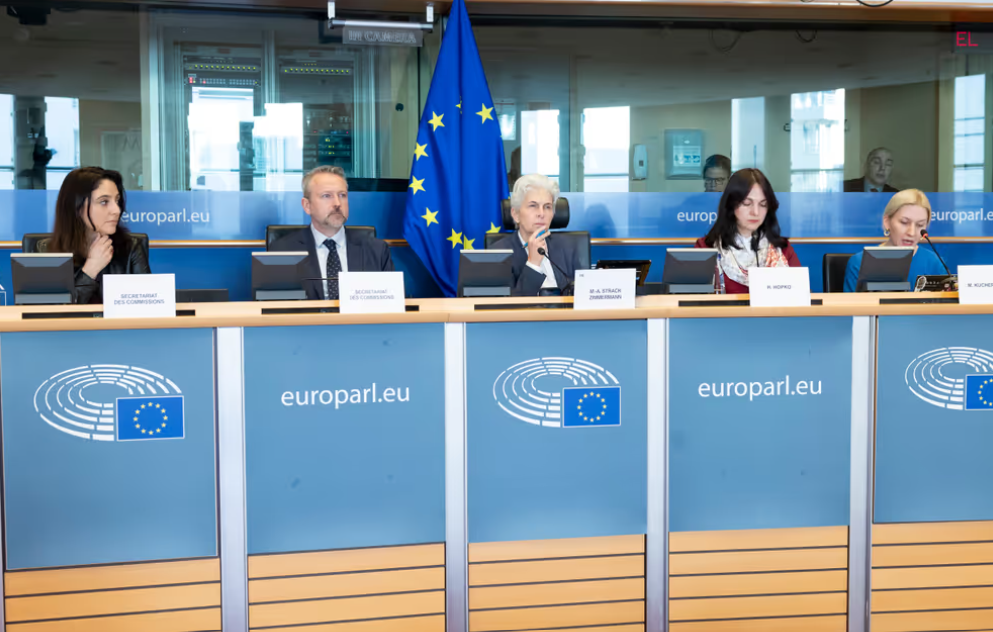
Below is Maria Kucherenko’s speech.
One of the main lessons that can be learned from the Ukrainian experience is the principle that should be unshakable for security as such and European security – to call a spade a spade. It is the wrong diagnosis that often prevents the right treatment: the fact that Ukraine spent the first eight years of the war proving that this was not a “smoldering conflict with separatists”, but an operation of the Russian Armed Forces under a false flag, which, however, did not exclude the participation of regular Russian Armed Forces in its pure form, in fact led to an even greater scale of aggression, and, ultimately, to the catastrophe of 2022. We argued in the Trilateral Contact Group in Minsk, in the Normandy format, that this was precisely the aggression of the Russian Federation. But Russia stubbornly tried to pretend that it did not concern it in any other way than as a mediator.
And this is exactly what the Russian Federation is doing now in Europe, when it uses the avatar of the Wagner Group to further conceal the true role of the General Staff of the Russian Armed Forces in classic sabotage against the countries of the European Union. It is beneficial for Russia to call this activity either the activities of the Wagner Group or the African Corps, although in reality the African Corps is simply a rebranding of the name of the Wagner Group, and the Wagner Group is a structure directly subordinate to the General Staff of the Russian Armed Forces. So, if we replace the wording of “Wagner bases” with “bases and centers of activity of the General Staff of the Russian Armed Forces”, then a completely disappointing picture emerges of how far the Russian Federation has actually gone in its attempts to test NATO as an alliance for reaction. Because in this case we are not talking about private players (according to Russian law, any PMCs are impossible in principle, this discussion has been going on inside the Russian Federation for quite some time, but it does not lead to legislative changes, nor does it lead to the elimination of the article of the Criminal Code for mercenary activity). We are talking about regular units of Russian military intelligence, which in fact means sabotage work of an enemy state on the territory of Europe on an ongoing basis.
Russia has meticulously mastered the technique of public distancing from the nature of its own aggressive actions. When this technique does not work, Russia resorts to another technique that it loves - externalizing the concept of security as such. This is a try to present any attempts at its own aggression as only "self-defense" or "defense of its interests, which were violated in one way or another." This is exactly how Russia's initial armed aggression against Ukraine in Crimea was explained - supposedly the residents of Crimea and Sevastopol needed to be protected from an alleged "anti-constitutional coup." This is exactly how the ultimatums of the Russian Foreign Ministry were put forward in 2021 - but already addressed to Ukraine's European partners and NATO as an alliance, with demands to return to the 1997 borders, because NATO expansion allegedly prevents Russia from feeling safe. The documents were even called the Treaty between the United States and Russia on Security Guarantees and the Agreement on Ensuring the Security of the Russian Federation and the Member States of the North Atlantic Alliance. Now, sabotage actions against Europe are explained in a similar way - they say that Europe's assistance to Ukraine poses a threat to Russia and therefore it considers itself entitled to violate European security. However, such distortions of reality cannot be categorically allowed even in negotiation formats, at the level of public rhetoric. Acts of aggression by the Russian Federation cannot be bought off by externalizing security.
Another important lesson from Ukraine for Europe is that Russia's war against Ukraine is not only and not so much tanks, and not direct combat operations as such. In 2014, Europe and the world were confused by a banal operation under a false flag in the form of “little green men” in Crimea. And the world order was destroyed precisely by this attempted annexation, because the solutions that were implemented after World War II did not work here. Russia did not let the world recover from the first shock and insisted on a pseudo-legalistic approach - supposedly it was about some kind of expression of will, the right of the people to self-determination and referendums. However, no legalistic explanations by Putin could not and cannot dominate international law - although it was precisely this approach that was finally enshrined by Russia with the so-called Constitutional reform of 2020. It is precisely on such confusion that Russia can and will be betting - what if aggression against Europe is dressed not in camouflage, but in gray clothes? What if we are talking about another pseudo-republic under the pretext of protecting this or that ethnic minority – for example, on the eastern borders of Europe? Shooting up an artificial rally of this or that minority by representatives of Russian special services is much cheaper than a full-fledged military operation. The consequences can be fatal – loss of control due to confusion, discrediting NATO as a defense alliance, which in any case will spend a significant amount of time on reaction. And this is just one example. These could also be attempts to repeat the famous march to Slatina – but now along the European route. In 1999, this was also an attempt to mask its activities – literally by repainting SFOR armored personnel carriers as KFOR.
It was then that the Deputy Minister of Defense of the Russian Federation Yunus-Bek Yevkurov gained his authority and a kind of fame in the eyes of the world's military intelligence. And it is Yevkurov who now oversees the activities of another instrument of the Russian Federation, which is designed to reformat the world order in a way that is beneficial to Russia - the African Corps. And this instrument, in turn, points to another lesson from Ukraine - war is global. This was proven by both the food crisis of 2022 and the challenges to maritime security created by this phase of the war. And there are no separate actions by Russia in Ukraine, in the Middle East, in North Africa or on land and at sea. There is a comprehensive approach that Russia uses - due to the projection of force, Russia also receives political opportunities to enter a particular region. After all, when it comes to the African Corps - it is not only and not so much about fighters on the ground, but about the work of political consultants, media workers, diplomats and their joint efforts. The most dangerous enemy on the Russian side does not necessarily have to be in uniform. Sometimes it is a military advisor – who can wear both a uniform and a suit, as Surovikin is currently doing in Algeria, moving between Algeria and Libya, but not limited to these countries. Often it is a well-trained person in civilian clothes who establishes connections, sells the services of people in uniform and ensures the desired result for Russia in international forums – for example, at the UN. Often these are people who manually organize migration crises with the help of refugees from Libya. Sometimes – these are specialists who win elections for pro-Russian candidates, who change the political landscape of the region. Sometimes – these are Rosatom specialists who start Trojan horses in the form of energy projects, after which, one way or another, representatives of Russian intelligence services enter the countries in the medium term. Sometimes it is Nikolai Patrushev himself, who now heads a monstrous structure called the Maritime Board of the Russian Federation. It unites the activities of Russian special services, almost all ministries, and heads of the maritime regions of the Russian Federation. To coordinate this body, a separate department for maritime security was created in the Presidential Administration, headed by Patrushev’s longtime associate Sergei Vakhrukov. And it is these people and President Putin who are responsible for the activities of the Shadow Fleet, which is used not only to circumvent sanctions against energy carriers, but also as a platform for further technical intelligence. And it is these people who will today impose their KGBist vision of the future of the Arctic on the world. And it is the emphasis on KGB methods, and not on purely military methods and classic military operations, that is and will be the main focus of the Russian Federation.
War has many dimensions, war can be dressed in different ways - both in uniform and in a diplomatic suit. But all this is war. Russia's war against Ukraine and Europe is always about the need to see the vertical of subordination of direct actors. And about the need to have the courage to call things by their rightful names.
Share